

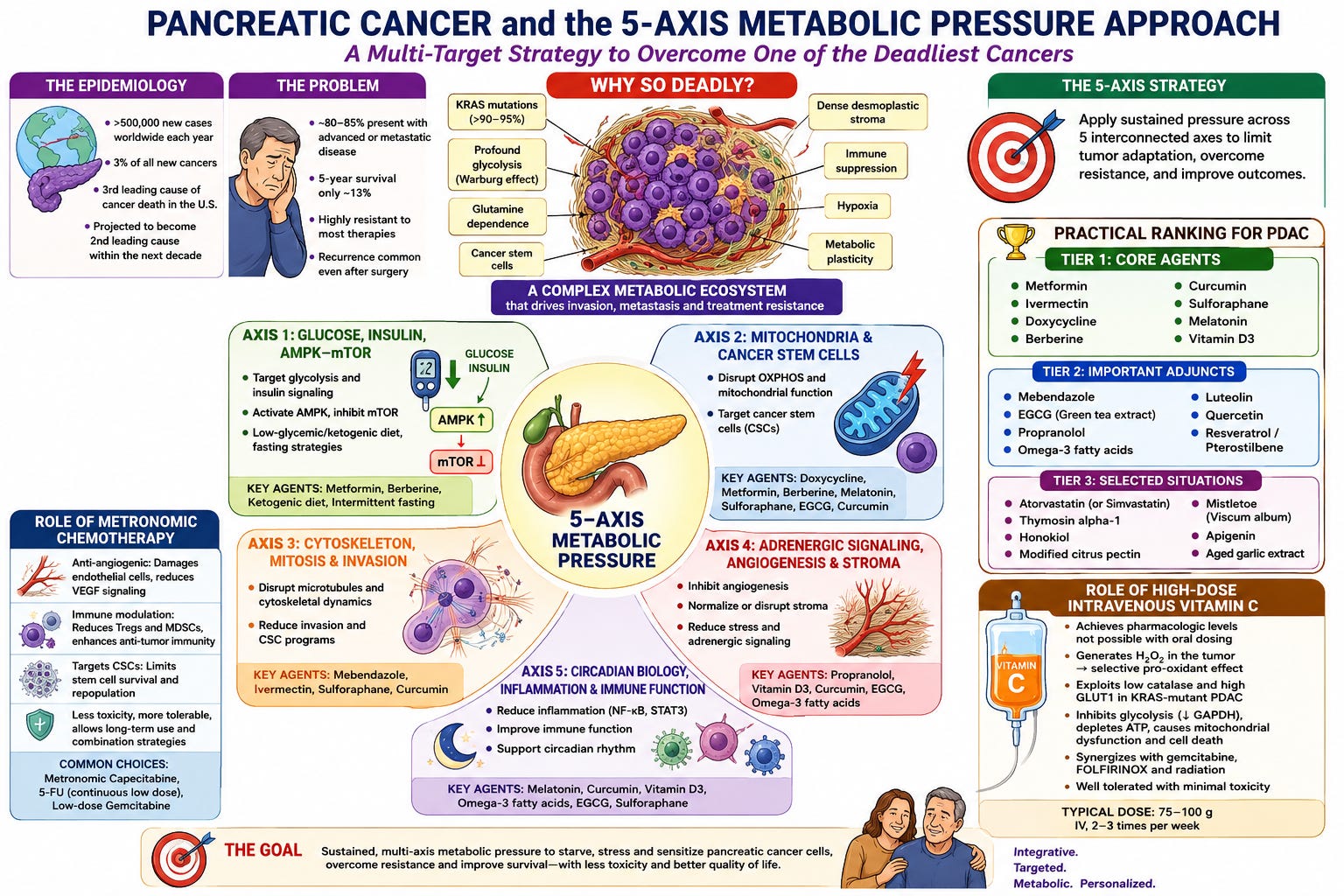
Pancreatic ductal adenocarcinoma (PDAC) is one of the deadliest human malignancies and remains among the greatest unmet challenges in oncology. Although it accounts for only about 3% of all new cancers, it is now the third leading cause of cancer-related death in the United States and is projected to become the second leading cause within the next decade. Worldwide, more than 500,000 new cases are diagnosed each year, and the incidence continues to rise, largely driven by aging populations, obesity, diabetes, and other metabolic disorders.
The prognosis of pancreatic cancer remains dismal. Because early-stage disease is usually asymptomatic, approximately 80–85% of patients present with locally advanced or metastatic disease that is not amenable to surgical resection. Even among patients who undergo potentially curative surgery, recurrence is common. Overall, the 5-year survival rate remains only about 13%, making pancreatic cancer one of the cancers with the poorest long-term outcomes despite decades of advances in surgery, chemotherapy, radiation therapy, and more recently, immunotherapy and targeted therapies.
The limited success of conventional treatments reflects the remarkable biological complexity of pancreatic cancer. Nearly 90–95% of tumors harbor activating KRAS mutations, resulting in profound metabolic reprogramming characterized by enhanced glycolysis (the Warburg effect), altered glutamine metabolism, macropinocytosis, autophagy, and exceptional metabolic flexibility. Pancreatic tumors are also distinguished by a dense desmoplastic stroma, marked immune suppression, extensive intratumoral hypoxia, and enrichment of therapy-resistant cancer stem cells. Together, these features create a highly resilient tumor ecosystem that promotes invasion, metastasis, and resistance to virtually every available therapy.
Rather than representing a single genetic disease, pancreatic cancer is better viewed as a complex metabolic ecosystem in which malignant cells continuously adapt to nutrient deprivation, hypoxia, therapeutic stress, and immune attack. This perspective helps explain why therapies directed against a single mutation or signaling pathway have generally produced only modest and short-lived clinical benefits.
The 5-Axis Metabolic Pressure Approach seeks to exploit these metabolic vulnerabilities by simultaneously targeting several complementary hallmarks of pancreatic cancer. The strategy aims to suppress glycolysis and insulin signaling, inhibit mitochondrial oxidative phosphorylation and cancer stem cells, disrupt cytoskeletal dynamics, attenuate adrenergic and angiogenic signaling, and reduce chronic inflammation while restoring circadian and immune homeostasis. By applying sustained pressure across multiple interconnected pathways rather than relying on a single target, this approach seeks to limit tumor adaptation and therapeutic resistance.
The discussion that follows reviews pancreatic cancer through the framework of the 5-Axis Metabolic Pressure model, highlighting the biological rationale for selected repurposed drugs and nutraceuticals. While many of these agents demonstrate promising preclinical activity and generally favorable safety profiles, it is important to emphasize that the proposed combinations remain hypothesis-driven and investigational. They should be considered potential adjuncts to—not replacements for—established oncologic therapies until validated in well-designed prospective clinical trials.
Pancreatic Cancer Through the 5-Axis Metabolic Lens
Pancreatic ductal adenocarcinoma is one of the strongest candidates for a metabolic oncology approach because it is driven by KRAS-mediated metabolic reprogramming, profound glycolysis, glutamine dependence, autophagy, macropinocytosis, cancer stem cells, dense stroma, immune suppression, and mitochondrial plasticity. Standard therapy remains essential—typically surgery when feasible, plus systemic therapy such as FOLFIRINOX or gemcitabine/nab-paclitaxel—but outcomes remain limited, making rational adjunctive strategies important.
Axis 1: Glucose, Insulin, AMPK–mTOR
PDAC is highly glycolytic and often arises in a terrain of insulin resistance, diabetes, obesity, or metabolic dysfunction. Therefore, the metabolic backbone should emphasize low-glycemic/ketogenic nutrition, avoidance of hyperinsulinemia, and AMPK activation.
Highest-priority agents:
Metformin, berberine, ketogenic/low-carbohydrate diet, fasting-mimicking or carefully supervised fasting strategies.
Metformin is biologically attractive because it activates AMPK, suppresses mTOR, reduces insulin signaling, and can impair mitochondrial complex I; however, clinical trials in unselected pancreatic cancer have not proven survival benefit.
Axis 2: Mitochondria and Cancer Stem Cells
Pancreatic cancer stem cells and treatment-resistant cells often rely heavily on OXPHOS and mitochondrial flexibility. This is why mitochondrial targeting is central in PDAC.
Highest-priority agents:
Doxycycline, metformin, berberine, melatonin, sulforaphane, EGCG, curcumin.
Doxycycline is especially rational because it inhibits mitochondrial protein synthesis, potentially weakening OXPHOS-dependent cancer stem cells. Metformin also has relevance because pancreatic cancer stem cells may rely on OXPHOS and can be vulnerable to mitochondrial inhibition.
Axis 3: Cytoskeleton, Mitosis, and Invasion
PDAC is invasive, migratory, and stromal. Disrupting cytoskeletal dynamics and cancer stem cell programs is therefore reasonable.
Highest-priority agents:
Mebendazole, ivermectin, sulforaphane, curcumin.
Mebendazole targets microtubules and may also affect Hedgehog and CSC-related pathways. Sulforaphane has preclinical evidence for suppressing pancreatic cancer stem-like phenotypes.
Axis 4: Adrenergic Signaling, Angiogenesis, and Stroma
PDAC is characterized by hypoxia, angiogenic signaling, stress biology, and dense desmoplastic stroma. The tumor microenvironment is a major barrier to chemotherapy and immune response.
Highest-priority agents:
Propranolol, vitamin D3, curcumin, EGCG, omega-3 fatty acids.
Vitamin D biology is especially interesting in PDAC because vitamin D receptor signaling in stromal cells has been investigated as a way to remodel the pancreatic tumor stroma and improve drug delivery.
Axis 5: Circadian Biology, Inflammation, and Immune Suppression
Pancreatic cancer is profoundly inflammatory and immunosuppressive, with NF-κB, STAT3, IL-6, macrophages, fibroblasts, and exhausted T cells contributing to resistance.
Highest-priority agents:
Melatonin, curcumin, vitamin D3, omega-3 fatty acids, EGCG, sulforaphane.
Melatonin is attractive because it supports circadian regulation, immune function, mitochondrial signaling, and apoptosis. Curcumin is highly relevant because it targets NF-κB, STAT3, inflammatory cytokines, EMT, and stromal signaling.
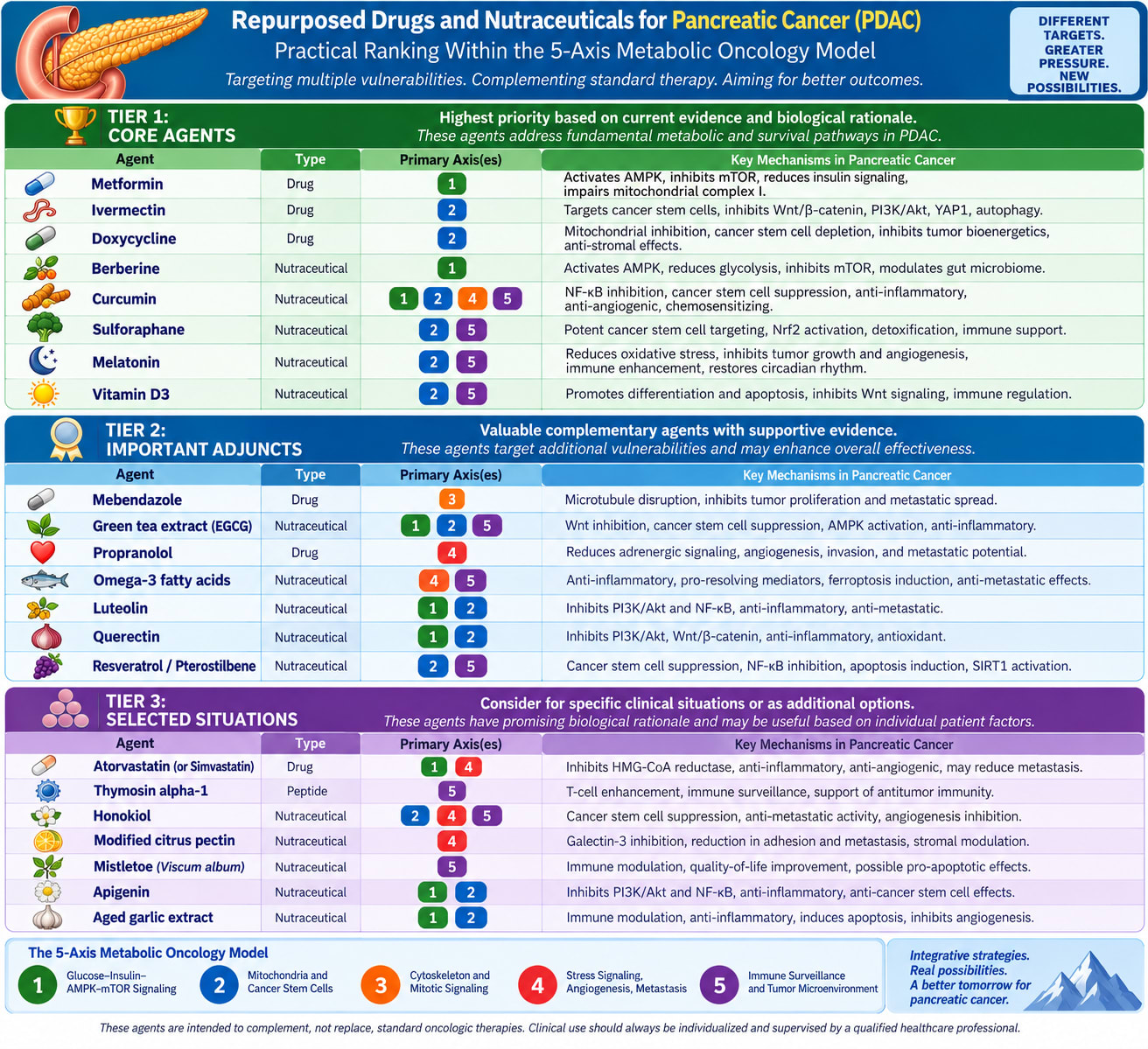
Practical Ranking for Pancreatic Cancer
Tier 1: Core Agents
Metformin
Ivermectin
Doxycycline
Berberine
Curcumin
Sulforaphane
Melatonin
Vitamin D3
Tier 2: Important Adjuncts
Mebendazole
Green tea extract (EGCG)
Propranolol
Omega-3 fatty acids
Luteolin
Quercetin
Resveratrol / Pterostilbene
Tier 3: Selected Situations
Atorvastatin (or Simvastatin)
Thymosin alpha-1
Honokiol
Modified citrus pectin
Mistletoe (Viscum album)
Apigenin
Aged garlic extract
Metronomic Chemotherapy
Evidence in Pancreatic Cancer
Compared with breast or colorectal cancer, clinical experience with metronomic chemotherapy in pancreatic cancer remains limited. Most studies have been small phase I or II trials evaluating maintenance therapy or combinations with targeted agents. While these studies generally demonstrate acceptable safety and disease stabilization in selected patients, they have not yet shown clear improvements in overall survival. Consequently, metronomic chemotherapy cannot currently be considered a standard treatment strategy for pancreatic cancer, although it remains an attractive investigational approach.
Which Drugs Are Most Suitable?
Among conventional agents, the strongest rationale exists for:
Capecitabine (oral fluoropyrimidine)
5-Fluorouracil (continuous infusion)
Gemcitabine (low-dose or prolonged infusion schedules)
Oral cyclophosphamide (less commonly studied in PDAC)
Of these, metronomic capecitabine is particularly attractive because it is orally administered, well tolerated, and has demonstrated anti-angiogenic and immunomodulatory activity across several solid tumors.
A Practical Strategy
For patients with advanced pancreatic cancer who have completed or are unable to tolerate intensive chemotherapy, a biologically rational maintenance approach could include:
Metronomic capecitabine (the best-studied oral option)
Metformin
Doxycycline
Ivermectin
Curcumin
Sulforaphane
Berberine
Melatonin
Vitamin D3
EGCG
Propranolol
Omega-3 fatty acids
This combination seeks to maintain continuous metabolic, mitochondrial, anti-angiogenic, and immunologic pressure while minimizing cumulative toxicity.
Pancreatic Cancer and KRAS Driver Mutation
Recently, the FDA approved daraxonrasib (RASONQUE), a first-in-class oral RAS-targeted therapy for adults with metastatic pancreatic adenocarcinoma who have received at least one prior systemic therapy or who are not candidates for multiagent systemic therapy. The approval represents an important advance for a malignancy in which therapeutic progress has historically been painfully slow.
In the randomized Phase III RASolute 302 trial involving 500 patients with previously treated metastatic pancreatic adenocarcinoma, median overall survival was 13.2 months with daraxonrasib compared with 6.7 months with standard chemotherapy. This corresponded to a hazard ratio for death of 0.40, or an estimated 60% reduction in the instantaneous risk of death during the study. Progression-free survival also improved substantially, from 3.6 to 7.2 months, while the objective response rate increased from 11% with chemotherapy to 30% with daraxonrasib. These are unusually large improvements for previously treated metastatic pancreatic cancer.
Daraxonrasib is particularly interesting because of how it attacks RAS biology. Rather than targeting one specific KRAS mutation, daraxonrasib is a RAS(ON) multi-selective inhibitor that targets the active, GTP-bound form of RAS proteins, including multiple oncogenic forms of KRAS as well as other RAS proteins. By suppressing active RAS signaling, the drug interferes with downstream pathways that promote cancer-cell proliferation, survival, and progression. It does not eliminate or “switch off” the mutant KRAS gene itself; rather, it inhibits the abnormal signaling generated by the RAS proteins.
This is especially relevant to pancreatic ductal adenocarcinoma because oncogenic KRAS mutations are present in more than 90% of tumors and are considered a principal driver of malignant transformation and tumor progression. RAS has historically been regarded as one of oncology’s most difficult therapeutic targets. The success of daraxonrasib therefore represents more than the introduction of another pancreatic cancer drug: it provides compelling clinical validation that broad inhibition of active RAS can translate into a major survival benefit in a highly RAS-dependent cancer.
However, daraxonrasib is not a cure, and resistance remains an important issue. Even with the striking improvement in survival, median progression-free survival was 7.2 months, indicating that most tumors eventually develop mechanisms that permit progression despite RAS inhibition. Understanding these adaptive escape pathways, and determining whether RAS inhibition can be combined effectively with chemotherapy, immunotherapy, metabolic interventions, or other targeted agents, will likely be the next major chapter in the treatment of pancreatic cancer.
Role of High-Dose Intravenous Vitamin C in Pancreatic Cancer
Among the many adjunctive therapies proposed for pancreatic cancer, high-dose intravenous vitamin C (IVC) has one of the strongest biological rationales and the most encouraging early clinical evidence. Unlike oral vitamin C, which is tightly regulated by intestinal absorption and cannot achieve pharmacologically active plasma concentrations, intravenous administration produces plasma levels that are 50–100 times higher, converting vitamin C from an antioxidant into a selective pro-oxidant within the tumor microenvironment.
Pancreatic ductal adenocarcinoma (PDAC) is particularly attractive for this approach because approximately 90–95% of tumors harbor KRAS mutations, which drive increased glucose uptake, oxidative stress, and metabolic vulnerability. Many pancreatic cancers also express low levels of catalase, the enzyme responsible for detoxifying hydrogen peroxide. This combination may render pancreatic cancer cells especially susceptible to the oxidative stress generated by pharmacologic vitamin C.
Mechanism of Action
At pharmacologic concentrations (typically achieved only by intravenous administration), vitamin C undergoes oxidation in the extracellular space, generating hydrogen peroxide (H₂O₂). Normal cells rapidly detoxify hydrogen peroxide through catalase, glutathione peroxidase, and other antioxidant systems. In contrast, many pancreatic cancer cells have impaired antioxidant defenses, allowing hydrogen peroxide to accumulate and induce oxidative DNA damage, mitochondrial dysfunction, ATP depletion, and ultimately apoptotic or necrotic cell death.
Beyond direct oxidative injury, high-dose IVC influences multiple pathways relevant to pancreatic cancer:
Selective generation of reactive oxygen species within the tumor
Depletion of intracellular ATP
Inhibition of glycolysis through inactivation of glyceraldehyde-3-phosphate dehydrogenase (GAPDH)
Increased oxidative stress in KRAS-mutant cells
Mitochondrial dysfunction
Reduced HIF-1α signaling
Inhibition of angiogenesis
Enhancement of immune function
Potential radiosensitization and chemosensitization
KRAS Mutations and Vitamin C
The relationship between KRAS mutations and vitamin C has generated considerable interest. KRAS-mutant pancreatic cancer cells exhibit markedly increased glucose uptake through GLUT1, which also transports the oxidized form of vitamin C, dehydroascorbic acid (DHA). Once inside the cell, DHA is reduced back to vitamin C at the expense of intracellular glutathione and NADPH, increasing oxidative stress and rendering cancer cells more susceptible to hydrogen peroxide-mediated injury.
Furthermore, oxidation of GAPDH impairs glycolysis, depriving these highly glycolytic tumors of their principal energy source. Thus, vitamin C simultaneously targets both redox homeostasis and tumor metabolism, creating a synthetic metabolic vulnerability.
Synergy with Chemotherapy
Perhaps the greatest clinical promise of IVC lies in its ability to enhance conventional chemotherapy. Multiple preclinical studies have demonstrated synergy between pharmacologic vitamin C and gemcitabine, with enhanced tumor cell killing compared with chemotherapy alone. Similar synergistic effects have been reported with fluoropyrimidines, platinum compounds, and radiation therapy.
Importantly, unlike many cytotoxic agents, high-dose IVC has generally been associated with minimal additional systemic toxicity, making it an attractive adjunct rather than an alternative to standard therapy.
Clinical Evidence
High-dose IV vitamin C is one of the most promising adjunctive metabolic therapies currently under investigation for pancreatic cancer. Unlike many complementary therapies that rely mainly on laboratory or anecdotal evidence, pharmacologic ascorbate now has mechanistic studies, early-phase clinical trials, and a randomized Phase II trial suggesting meaningful improvements in overall survival and progression-free survival when added to standard chemotherapy.
The first randomized Phase II trial evaluating high-dose intravenous (IV) vitamin C in metastatic pancreatic cancer was published in 2024 by investigators at the University of Iowa. Thirty-six patients with previously untreated metastatic pancreatic ductal adenocarcinoma were randomized to receive either standard chemotherapy (gemcitabine plus nab-paclitaxel) alone or the same chemotherapy combined with 75 g of IV vitamin C administered three times weekly.
The addition of pharmacologic ascorbate resulted in a marked improvement in clinical outcomes. Median overall survival increased from 8.3 months to 16.0 months (hazard ratio [HR] 0.46; P = 0.03), representing an approximately 54% reduction in the risk of death. Median progression-free survival also improved, increasing from 3.9 months to 6.2 months (HR 0.43; P = 0.029). Importantly, treatment was well tolerated and did not increase chemotherapy-related toxicity. Patients receiving IV vitamin C remained on chemotherapy longer and received higher cumulative doses of treatment than those receiving chemotherapy alone.
Although limited by its small sample size and single-center design, this study provides the strongest clinical evidence to date that high-dose IV vitamin C may significantly enhance the efficacy of standard chemotherapy in metastatic pancreatic cancer. Confirmation in larger multicenter Phase III trials is required before pharmacologic ascorbate can be recommended as part of routine standard care.
Reference: Cullen JJ, Wagner BA, Buettner GR, et al. A randomized phase II trial of pharmacological ascorbate combined with gemcitabine and nab-paclitaxel for metastatic pancreatic cancer. Redox Biology. 2024;76:103318.
Practical Clinical Use
Among patients with advanced pancreatic cancer receiving systemic chemotherapy, high-dose IVC is biologically most attractive in:
KRAS-mutant pancreatic cancer
Combination with gemcitabine-based chemotherapy
Combination with FOLFIRINOX (investigational)
Patients with adequate renal function
Patients without glucose-6-phosphate dehydrogenase (G6PD) deficiency
Patients without a history of recurrent calcium oxalate kidney stones
Typical protocols administer 75–100 g intravenously two or three times weekly, although dosing varies among centers.
Overall Perspective
Among all repurposed metabolic therapies, high-dose intravenous vitamin C has one of the strongest mechanistic rationales for pancreatic cancer. Its ability to exploit the metabolic vulnerabilities of KRAS-mutant tumors, selectively generate oxidative stress, inhibit glycolysis, impair mitochondrial function, and enhance chemotherapy makes it a particularly attractive adjunct within the 5-Axis Metabolic Pressure Approach. Although definitive randomized clinical trials are still lacking, the combination of compelling biology, encouraging early clinical studies, and an excellent safety profile places high-dose IVC among the most promising adjunctive therapies for pancreatic ductal adenocarcinoma.
Within the 5-Axis framework, I would classify high-dose intravenous vitamin C as a Tier 1 adjunctive therapy for pancreatic cancer, particularly when used alongside standard chemotherapy in appropriately selected patients after screening for G6PD deficiency and renal impairment.
Bottom Line
Pancreatic cancer is not simply a genetic disease; it is a metabolic, stromal, inflammatory, and immune-suppressive ecosystem. The 5-Axis approach is biologically compelling because it simultaneously targets glucose metabolism, mitochondrial OXPHOS, cancer stem cells, invasion, angiogenesis, stroma, inflammation, and immune dysfunction. However, this remains a hypothesis-driven adjunctive framework, not a proven replacement for standard oncologic therapy.
If you’ve found this work valuable, please consider upgrading to a paid subscription. Your support helps me continue independent research and share practical, evolving insights—while giving you access to deeper content and more direct engagement.

Medical Disclaimer: The discussion of repurposed medications and nutraceuticals in this article is intended to review the scientific literature and does not constitute a recommendation for self-treatment. Decisions regarding the use of off-label therapies should be made in consultation with a qualified healthcare professional familiar with the patient’s medical history and current treatment plan. Please see the full Medical Disclaimer on the introductory page to Marik’s Cancer & Metabolic Healing Playbook.
Berkson protocol for cancer, it is an integrative regimen developed by Burton Berkson centered on intravenous α-lipoic acid (ALA) plus low-dose naltrexone (LDN). It is particularly known because of several published reports involving advanced pancreatic cancer. A recent review of LDN found that oncology evidence remains sparse; the identified randomized cancer trial involved LDN in high-grade glioma and did not demonstrate significant improvement in its measured fatigue or quality-of-life endpoints. For the Pancreatic Cancer Library, I would therefore classify the Berkson protocol approximately as:
Biological plausibility: interesting → Preclinical rationale: supportive but incomplete → Human evidence: case reports only → Clinical efficacy: unproven.
I will be doing a post on GBM soon