

The recently published EVITA trial suggests that vitamin C may matter in patients with early myeloid neoplasms, although perhaps not for the reason originally hypothesized (1). Oral supplementation did not significantly slow expansion of the malignant clone. However, an exploratory analysis found substantially longer overall survival in the vitamin C group, and most of the difference in deaths was attributed to bacterial infection.
These findings are particularly interesting when read alongside the extensive literature documenting profound vitamin C depletion in sepsis and critical illness. Together, they point to host defense, rather than the malignant clone, as the more likely site of benefit.
The EVITA trial: design and principal findings
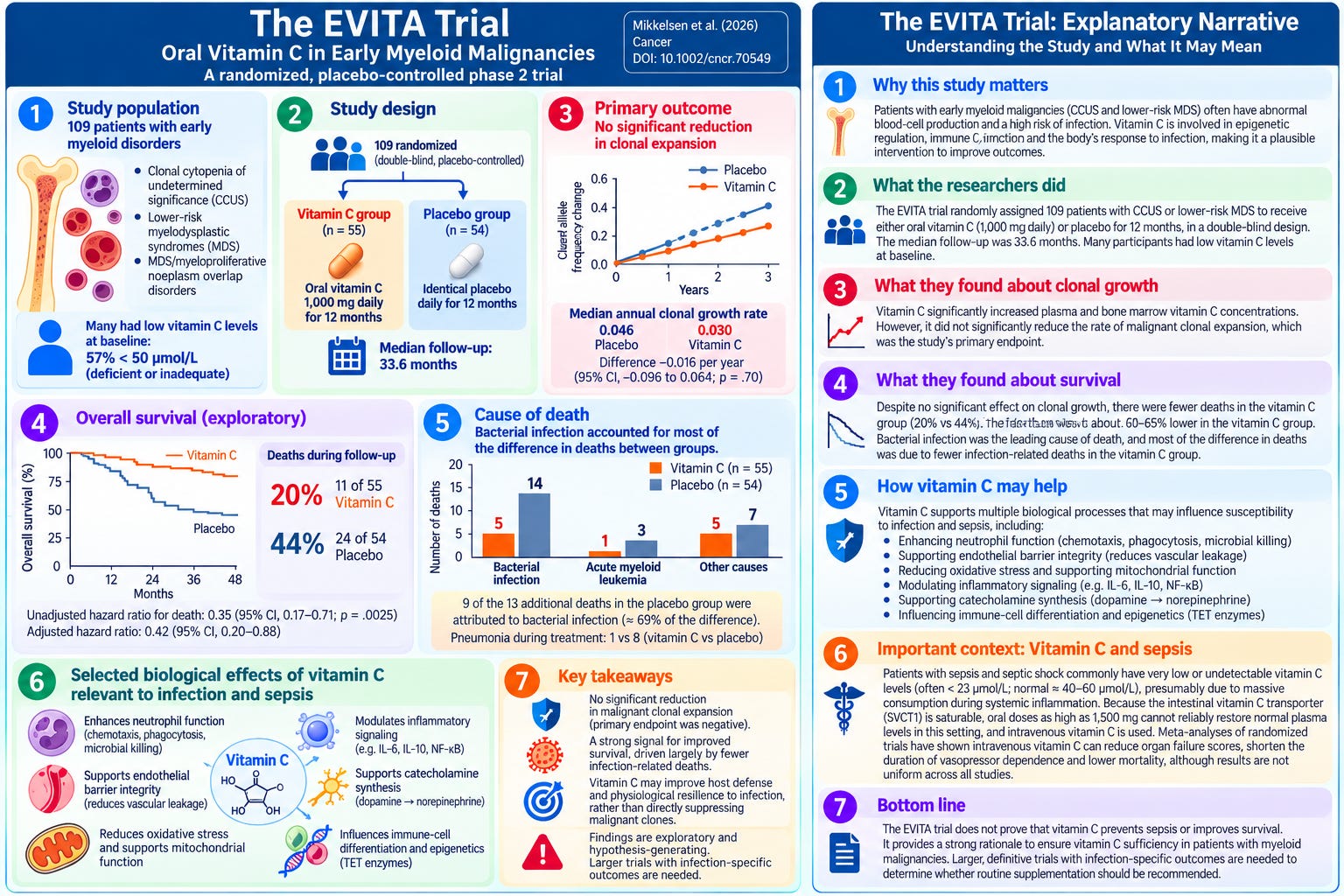
EVITA was a randomized, double-blind, placebo-controlled phase 2 trial of 109 patients with clonal cytopenia of undetermined significance (CCUS) or lower-risk myeloid malignancies, including myelodysplastic syndromes (MDS) (1). Participants received oral vitamin C 1,000 mg daily (n = 55) or placebo (n = 54) for 12 months. Median follow-up was 33.6 months.
At baseline, 57% of participants (62 of 109) had deficient or inadequate vitamin C status, defined as a plasma concentration below 50 µmol/L. Supplementation corrected this. Median plasma vitamin C rose from 45.9 to 81.9 µmol/L in the vitamin C group, compared with 43.8 to 48.7 µmol/L in the placebo group (1). The investigators also found a strong correlation between plasma and bone marrow vitamin C concentrations, indicating that the increase reached the hematopoietic compartment.
Thus, 1 g of oral vitamin C daily was sufficient to bring these outpatients into the upper physiological range. This is consistent with healthy-volunteer pharmacokinetics, in which plasma concentrations plateau at about 70–80 µmol/L with intakes of roughly 200–1,000 mg/day (2, 3). In effect, EVITA compared restored vitamin C sufficiency with persistently marginal status, not two groups with equivalent vitamin C status.
Effects on the malignant clone and on survival
Vitamin C is an essential cofactor for the ten-eleven translocation (TET) dioxygenases, which drive DNA demethylation and regulate hematopoietic stem cell differentiation. Loss-of-function TET2 mutations are among the most common lesions in clonal hematopoiesis and MDS, and in experimental models ascorbate restores TET2 activity and suppresses leukemic progression (4, 5).
Despite this biological rationale, vitamin C did not significantly reduce clonal expansion, the trial’s primary endpoint. The median clonal growth rate was 0.030 per year with vitamin C and 0.046 per year with placebo (difference −0.016; 95% CI, −0.096 to 0.064; P = .70) (1). Progression to higher-risk myeloid disease was numerically, but not significantly, less frequent (5 vs 9 events; HR 0.51; 95% CI, 0.17–1.51).
By contrast, an exploratory post hoc survival analysis showed a striking difference (Figure 1). There were 11 deaths in the vitamin C group and 24 in the placebo group. The unadjusted hazard ratio for death was 0.35 (95% CI, 0.17–0.71; P = .0025), corresponding to a 65% lower estimated hazard of death. The association persisted after adjustment for age, sex, baseline hemoglobin, and CCUS diagnosis (HR 0.42; 95% CI, 0.20–0.88) (1).
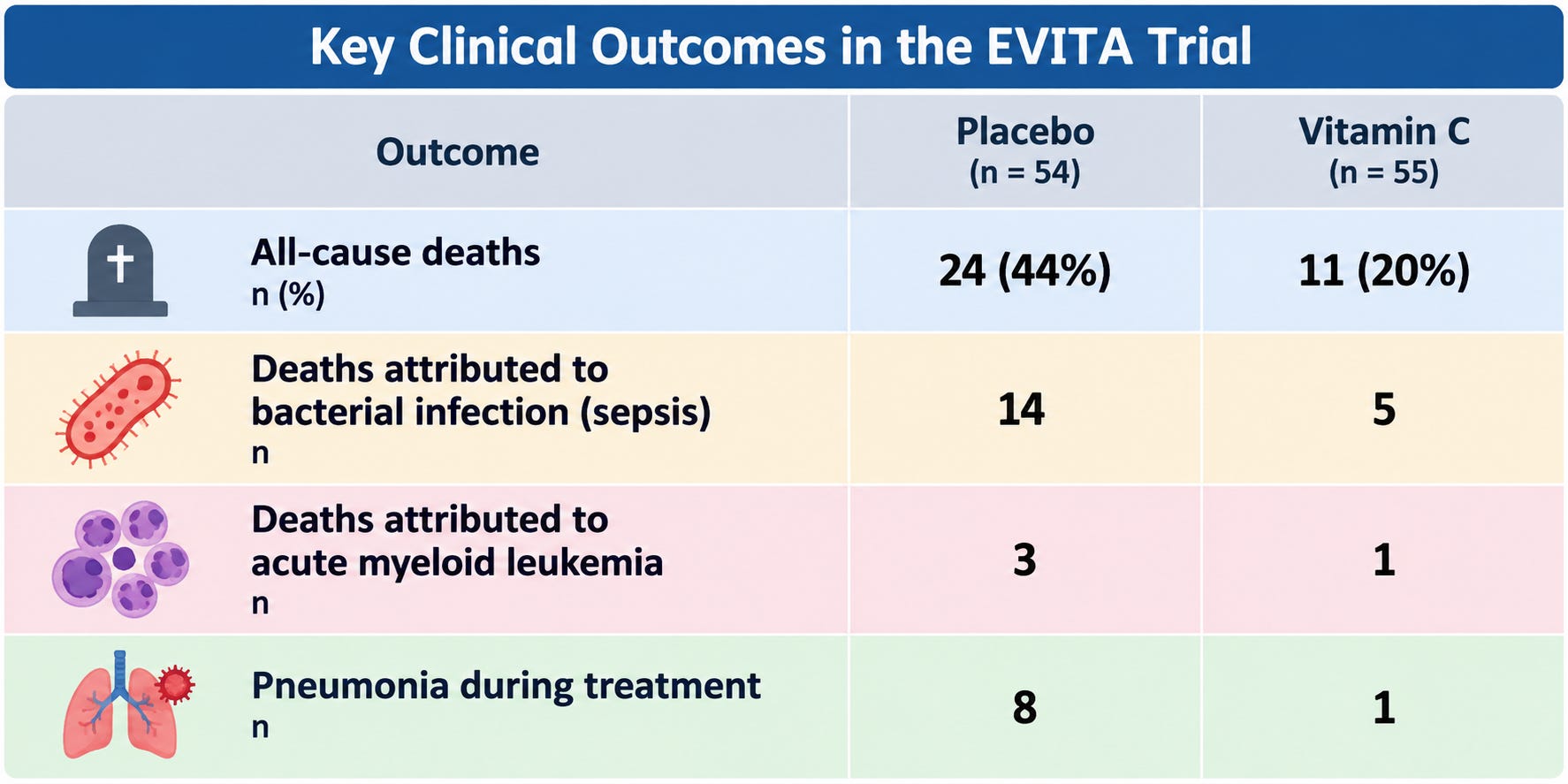
Figure 1. Key clinical outcomes in the EVITA trial. Data from Mikkelsen et al. (1).
Bacterial infection was the leading cause of death in both arms, accounting for 14 of 24 deaths in the placebo group and 5 of 11 in the vitamin C group (1). In other words, 9 of the 13 excess deaths in the placebo group (approximately 69%) were infection-related. Serious adverse events were also less frequent with vitamin C (33% vs 57%).
This exploratory finding cannot establish causality. It does, however, raise an important possibility: vitamin C may improve survival in myeloid neoplasms through effects on immune function and host resilience, rather than exclusively through suppression of the malignant clone.
Vitamin C depletion in sepsis: a physiological parallel
A similar, but usually more severe, disturbance in vitamin C status occurs in critically ill patients with sepsis and septic shock. Plasma vitamin C status is commonly classified as adequate (≥50 µmol/L), inadequate (23–50 µmol/L), hypovitaminosis C or marginal deficiency (11–23 µmol/L), and deficient (<11 µmol/L), the range in which scurvy can develop (3, 6). These values are in micromoles per liter (µmol/L), not millimoles per liter.
In a prospective study of critically ill patients receiving guideline-recommended enteral or parenteral nutrition, mean plasma vitamin C in septic shock was 15.3 µmol/L. Eighty-eight percent of these patients had hypovitaminosis C and 38% were frankly deficient (7). Similarly low baseline concentrations were found in the early phase I study of intravenous vitamin C in severe sepsis (8).
Depletion in sepsis is multifactorial. Contributors include accelerated consumption by oxidative stress and activated neutrophils, use as a cofactor for endogenous norepinephrine and vasopressin synthesis, redistribution into leukocytes and tissues, reduced intake, and renal and extracorporeal losses (7, 9, 10). Increased consumption during severe systemic inflammation is probably the dominant mechanism, although the contribution of each factor is difficult to quantify.
Why oral vitamin C may be insufficient in septic shock
Intestinal absorption of vitamin C is mediated principally by the sodium-dependent vitamin C transporter 1 (SVCT1), which is saturable (11). As oral doses increase, fractional absorption falls and renal excretion rises. Oral dosing therefore keeps plasma concentrations within a narrow range, whereas intravenous administration bypasses these controls and can produce concentrations up to about 70-fold higher (2, 12).
In septic shock, requirements are greatly increased, and gut absorption may be further compromised by hypoperfusion and ileus. Under these conditions, conventional oral supplementation is unlikely to correct severe depletion quickly. Pharmacokinetic studies in critically ill patients indicate that intravenous doses of about 2–3 g/day are needed to restore normal plasma concentrations (7, 13). This is the rationale for investigating intravenous vitamin C in sepsis.
Saturable absorption does not mean that oral vitamin C cannot correct deficiency; EVITA shows that it does in stable outpatients. Whether oral dosing is sufficient depends on the clinical setting, absorption, ongoing losses, and the rate of utilization. The contrast is informative: patients with relatively stable myeloid disorders achieved sufficiency with 1,000 mg orally each day, whereas patients in septic shock are likely to require intravenous administration for rapid repletion.
Does intravenous vitamin C benefit patients with sepsis?
The evidence is more nuanced than the frequent assertion that intravenous vitamin C has no effect, but it is not settled. Physiological benefits are reasonably consistent: meta-analyses report shorter vasopressor duration and greater improvement in Sequential Organ Failure Assessment Score - SOFA score (14, 15). Mortality results, by contrast, conflict. A 2022 meta-analysis of 10 randomized trials (755 patients) reported lower short-term mortality (odds ratio 0.51; 95% CI, 0.37–0.69) (14). A larger 2023 meta-analysis of 18 trials (3,364 patients) found no significant overall effect (odds ratio 0.89; 95% CI, 0.77–1.04); however, benefit was confined to the 25–100 mg/kg/day dose subgroup. (15). Most recently, a 2026 meta-analysis of 14 monotherapy trials (1,958 patients) reported lower 28-day mortality (risk ratio 0.70; 95% CI, 0.53–0.93), although heterogeneity was moderate (I² = 52%) (16).
Differences in the timing, dose, and duration of treatment probably account for much of this inconsistency, and timing appears to be particularly important. In the original before-after study, hydrocortisone, vitamin C, and thiamine were started early in the course of septic shock (17). Long et al. subsequently examined timing directly in a retrospective cohort of 206 patients with septic shock, 79 of whom received the same combination, including vitamin C 1.5 g every 6 hours (18). APACHE-adjusted ICU mortality was lower in the treated cohort (odds ratio 0.44; 95% CI, 0.18–0.97). This benefit was confined to patients treated within 6 hours of presentation (odds ratio 0.08; 95% CI, 0.00–0.59); no benefit was seen when treatment began 6–24 hours after presentation (odds ratio 0.66; 95% CI, 0.27–1.50).
Most randomized trials, by contrast, allowed enrollment up to 24 hours after the onset of shock or ICU admission. In VITAMINS, for example, the median time from ICU admission to randomization was about 12 hours, and this delay followed time already spent in the emergency department or ward (19). Treatment was also usually limited to 4 days or less, which may be too short (20).
Early administration alone has not, however, resolved the question. The C-EASIE trial gave vitamin C 1.5 g every 6 hours for 4 days, starting within 6 hours of emergency department presentation, to 300 patients (21). It found no significant reduction in organ dysfunction or 28-day mortality (18.4% vs 20.0%). Most of these patients were, however, considerably less severely ill than those enrolled in ICU trials, and in an exploratory subgroup with a baseline SOFA score of 6 or higher, vitamin C was associated with lower SOFA scores.
It is therefore inaccurate to claim that intravenous vitamin C has no biological or clinical effect in sepsis. Equally, a consistent survival benefit has not been demonstrated. The available data suggest that timing, dose, and severity of illness all matter. The hypothesis that early intravenous vitamin C reduces mortality in the most severely ill patients with septic shock therefore remains credible, but it has not yet been adequately tested.
Why these findings matter for hematological malignancies
Patients with MDS and related myeloid disorders have impaired host defenses, including neutropenia and qualitative defects in neutrophil function. Infection is a leading cause of hospitalization and death in this population (22, 23).
Neutrophils accumulate vitamin C to millimolar intracellular concentrations, and vitamin C supports neutrophil chemotaxis, phagocytosis, microbial killing, and apoptosis and clearance of spent neutrophils. It also contributes to endothelial barrier integrity, regulation of inflammatory signaling, redox homeostasis, and catecholamine synthesis (9, 10).
The EVITA findings therefore support a specific hypothesis: correcting vitamin C inadequacy may improve the capacity to withstand serious infection, even without directly inhibiting malignant clonal growth. The mortality data are consistent with this possibility but cannot establish it. The survival analysis was post hoc and based on a small number of events. Infection-related deaths were not formally adjudicated as sepsis deaths, and the trial did not test whether fewer infections mediated the survival difference.
Conclusion
The EVITA trial makes four observations of potential clinical relevance:
1. Vitamin C inadequacy was common in patients with early myeloid neoplasms, affecting 57% of participants.
2. Oral vitamin C 1,000 mg daily restored plasma concentrations to the physiological range, with corresponding increases in bone marrow vitamin C.
3. Vitamin C did not significantly suppress malignant clonal expansion, yet the supplemented group had substantially fewer deaths during follow-up.
4. Most of the difference in mortality was attributable to bacterial infection. This suggests that the effects of vitamin C on host defense may be as important as its effects on malignant hematopoiesis.
The sepsis literature strengthens the biological rationale for this hypothesis. Severe vitamin C depletion is common in critical illness, and intravenous repletion improves several physiological outcomes, although a consistent survival benefit remains unproven.
The practical implication is that vitamin C deserves greater attention in the supportive care of patients with hematological malignancies and premalignant clonal disorders. The appropriate objective is to ensure vitamin C sufficiency, not to prescribe high-dose vitamin C indiscriminately. Correcting inadequacy is low-cost, low-risk, and physiologically justified, and EVITA shows that 1 g/day orally achieves it in stable outpatients. Whether supplementation benefits patients who are already vitamin C replete, and whether it reduces infection-related mortality, remain unanswered.
The distinction matters. There is a strong physiological rationale for avoiding vitamin C deficiency in these patients, but not yet sufficient clinical evidence to recommend universal supplementation as an anticancer or infection-prevention therapy. That question should be answered by an adequately powered phase 3 trial with baseline vitamin C measurement and prospectively adjudicated infection and sepsis endpoints.

References
1. Mikkelsen SU, Al-Mousawi A, Puglisi AB, et al. Oral vitamin C supplementation in patients with clonal cytopenia of undetermined significance or lower-risk myeloid malignancies: results from EVITA, a phase 2 randomized, placebo-controlled trial. Cancer. 2026;132(19):e70549. doi:10.1002/cncr.70549
2. Levine M, Conry-Cantilena C, Wang Y, et al. Vitamin C pharmacokinetics in healthy volunteers: evidence for a recommended dietary allowance. Proc Natl Acad Sci U S A. 1996;93(8):3704-3709. doi:10.1073/pnas.93.8.3704
3. Lykkesfeldt J, Tveden-Nyborg P. The pharmacokinetics of vitamin C. Nutrients. 2019;11(10):2412. doi:10.3390/nu11102412
4. Cimmino L, Dolgalev I, Wang Y, et al. Restoration of TET2 function blocks aberrant self-renewal and leukemia progression. Cell. 2017;170(6):1079-1095.e20. doi:10.1016/j.cell.2017.07.032
5. Agathocleous M, Meacham CE, Burgess RJ, et al. Ascorbate regulates haematopoietic stem cell function and leukaemogenesis. Nature. 2017;549(7673):476-481. doi:10.1038/nature23876
6. Schleicher RL, Carroll MD, Ford ES, Lacher DA. Serum vitamin C and the prevalence of vitamin C deficiency in the United States: 2003–2004 National Health and Nutrition Examination Survey (NHANES). Am J Clin Nutr. 2009;90(5):1252-1263. doi:10.3945/ajcn.2008.27016
7. Carr AC, Rosengrave PC, Bayer S, Chambers S, Mehrtens J, Shaw GM. Hypovitaminosis C and vitamin C deficiency in critically ill patients despite recommended enteral and parenteral intakes. Crit Care. 2017;21(1):300. doi:10.1186/s13054-017-1891-y
8. Fowler AA 3rd, Syed AA, Knowlson S, et al. Phase I safety trial of intravenous ascorbic acid in patients with severe sepsis. J Transl Med. 2014;12:32. doi:10.1186/1479-5876-12-32
9. Carr AC, Shaw GM, Fowler AA, Natarajan R. Ascorbate-dependent vasopressor synthesis: a rationale for vitamin C administration in severe sepsis and septic shock? Crit Care. 2015;19:418. doi:10.1186/s13054-015-1131-2
10. Carr AC, Maggini S. Vitamin C and immune function. Nutrients. 2017;9(11):1211. doi:10.3390/nu9111211
11. Savini I, Rossi A, Pierro C, Avigliano L, Catani MV. SVCT1 and SVCT2: key proteins for vitamin C uptake. Amino Acids. 2008;34(3):347-355. doi:10.1007/s00726-007-0555-7
12. Padayatty SJ, Sun H, Wang Y, et al. Vitamin C pharmacokinetics: implications for oral and intravenous use. Ann Intern Med. 2004;140(7):533-537. doi:10.7326/0003-4819-140-7-200404060-00010
13. de Grooth HJ, Manubulu-Choo WP, Zandvliet AS, et al. Vitamin C pharmacokinetics in critically ill patients: a randomized trial of four IV regimens. Chest. 2018;153(6):1368-1377. doi:10.1016/j.chest.2018.02.025
14. Zhu H, Xu X, Zhang K, Ye Q. The effect of intravenous vitamin C on clinical outcomes in patients with sepsis or septic shock: a meta-analysis of randomized controlled trials. Front Nutr. 2022;9:964484. doi:10.3389/fnut.2022.964484
15. Liang B, Su J, Shao H, et al. The outcome of IV vitamin C therapy in patients with sepsis or septic shock: a meta-analysis of randomized controlled trials. Crit Care. 2023;27(1):109. doi:10.1186/s13054-023-04392-y
16. Cai B, Xiao Q, Xia Y, et al. Intravenous vitamin C as micronutrient therapy in patients with sepsis or septic shock: an updated systematic review and meta-analysis of randomized controlled trials. Front Nutr. 2026;13:1905726. doi:10.3389/fnut.2026.1905726
17. Marik PE, Khangoora V, Rivera R, Hooper MH, Catravas J. Hydrocortisone, vitamin C, and thiamine for the treatment of severe sepsis and septic shock: a retrospective before-after study. Chest. 2017;151(6):1229-1238. doi:10.1016/j.chest.2016.11.036
18. Long MT, Frommelt MA, Ries MP, Murray M, Osman F, Krause BM, Kory P. Early hydrocortisone, ascorbate and thiamine therapy for severe septic shock. Crit Care Shock. 2020;23(1):23-34.
19. Fujii T, Luethi N, Young PJ, et al. Effect of vitamin C, hydrocortisone, and thiamine vs hydrocortisone alone on time alive and free of vasopressor support among patients with septic shock: the VITAMINS randomized clinical trial. JAMA. 2020;323(5):423-431. doi:10.1001/jama.2019.22176
20. Lee HJ, Kim OH, Baek MS, Kim WY. Vitamin C for septic shock in previous randomized trials: implications of erroneous dosing, timing, and duration. Crit Care. 2022;26(1):61. doi:10.1186/s13054-022-03946-w
21. Vandervelden S, et al. Early administration of vitamin C in patients with sepsis or septic shock in emergency departments: a multicenter, double-blind, randomized controlled trial: the C-EASIE trial. Crit Care. 2025;29(1):160. doi:10.1186/s13054-025-05383-x
22. Toma A, Fenaux P, Dreyfus F, Cordonnier C. Infections in myelodysplastic syndromes. Haematologica. 2012;97(10):1459-1470. doi:10.3324/haematol.2012.063420
23. Nachtkamp K, Stark R, Strupp C, et al. Causes of death in 2877 patients with myelodysplastic syndromes. Ann Hematol. 2016;95(6):937-944. doi:10.1007/s00277-016-2649-3
Yes, this study raises several important and thought-provoking questions. Ideally, the findings should be confirmed in a larger randomized controlled trial. However, given the encouraging results, I would be reluctant to accept placebo if I were a patient in such a trial, although whether genuine clinical equipoise still exists remains debatable.
My view is that vitamin C supplementation at 1 g daily deserves serious consideration in patients with hematological malignancies. It is inexpensive, well tolerated, and readily accessible. While definitive evidence of clinical benefit is still needed, the potential benefits, low cost, and favorable safety profile make this an intervention worthy of serious discussion.
Thanks. I must say I dont really understand this Zeta potential business... it is to complex for my simple brain. Einstein once said "make it as simple as you can but not any simpler"