

Resveratrol (3,40,5-trihydroxy-trans-stilbene) is a non-flavonoid polyphenol that occurs naturally in many species of plants, including peanuts, grapes, and berries. (1) Pterostilbene is a naturally occurring analog of resveratrol.
A significant amount of research, including preclinical, clinical, and epidemiological studies, has indicated that dietary consumption of polyphenols, found at high levels in vegetables and fruits, may prevent the evolution of an array of diseases, including cancer. (1) Resveratrol and other flavonoids (quercetin, turmeric) have numerous anticancer activities.
Resveratrol exerts anticancer effects by targeting multiple hallmarks of cancer, including cell proliferation, survival, inflammation, angiogenesis, metastasis, and drug resistance, across all stages of carcinogenesis (initiation, promotion, progression). Its actions are largely mediated through modulation of key signaling pathways (e.g., PI3K/AKT/mTOR, NF‑κB, JAK/STAT3), induction of apoptosis and autophagy, cell‑cycle arrest, and epigenetic regulation.(2)
Anticancer pathways and mechanisms
Resveratrol is a polyphenolic stilbene that shows chemopreventive and therapeutic activity in diverse tumor types in vitro and in vivo, with relative selectivity for cancer over normal cells.(3) It interferes with all three stages of carcinogenesis by detoxifying carcinogens, protecting DNA from oxidative damage, and suppressing tumor promotion and progression via growth factor and inflammatory signaling.(2)
Resveratrol has been reported to possess significant anticancer property in various preclinical animal models. (1) Resveratrol affects a variety of cancer stages, from initiation and promotion to progression, by affecting the diverse signal-transduction pathways that control cell growth and division, inflammation, apoptosis, metastasis, and angiogenesis. It has been shown that resveratrol has in vitro cytotoxic effects against a large range of human tumor cells, including myeloid and lymphoid cancer cells, and breast, skin, cervix, ovary, stomach, prostate, colon, liver, pancreas, and thyroid carcinoma cells. (1, 4-6)
Studies conducted in vitro have discovered that resveratrol exerts an anti-proliferative activity by inducing apoptosis. Resveratrol directly inhibits tumor cell proliferation by downregulating growth factor signaling (e.g., EGFR, VEGF) and receptor tyrosine kinase–driven cascades such as AKT/mTOR.(3) Resveratrol modulates multiple oncogenic pathways, including PI3K/AKT/mTOR, JAK/STAT3, MAPKs, and Wnt/β‑catenin, resulting in reduced survival signaling and increased tumor suppressor activity (e.g., PTEN, FOXO). (2) Resveratrol modifies the balance of cyclins as well as cyclin-dependent kinases (CDKs), resulting in cell cycle inhibition at G0/G1 phase. (7) Resveratrol causes activation of the p53-dependent pathway. (8) The inhibition of anti-apoptotic proteins of the Bcl-2 family, and activation of pro-apoptotic proteins such as Bad, Bak or Bax, by resveratrol has also been shown to be a mechanism for caspase activation and cytochrome c release. (9) It has also been shown that resveratrol induces apoptosis via inhibiting the PI3K/Akt/mTOR pathway, modulating the mitogen-activated protein kinase pathway (MAPK) and inhibiting NF-ΚB activation. (1) Resveratrol causes inhibition of signal transducers and activators of transcription 3 (STAT3), which adds to its pro-apoptotic and anti-proliferative potential. (10) Resveratrol exerts strong anti‑inflammatory effects by inhibiting NF‑κB activation and TNF‑α–driven transcriptional programs, thereby reducing pro‑tumorigenic cytokines, COX‑2, and iNOS expression. (3) In addition, resveratrol may inhibit cancer stem cells. (11)
Figure 1. Resveratrol anticancer pathways
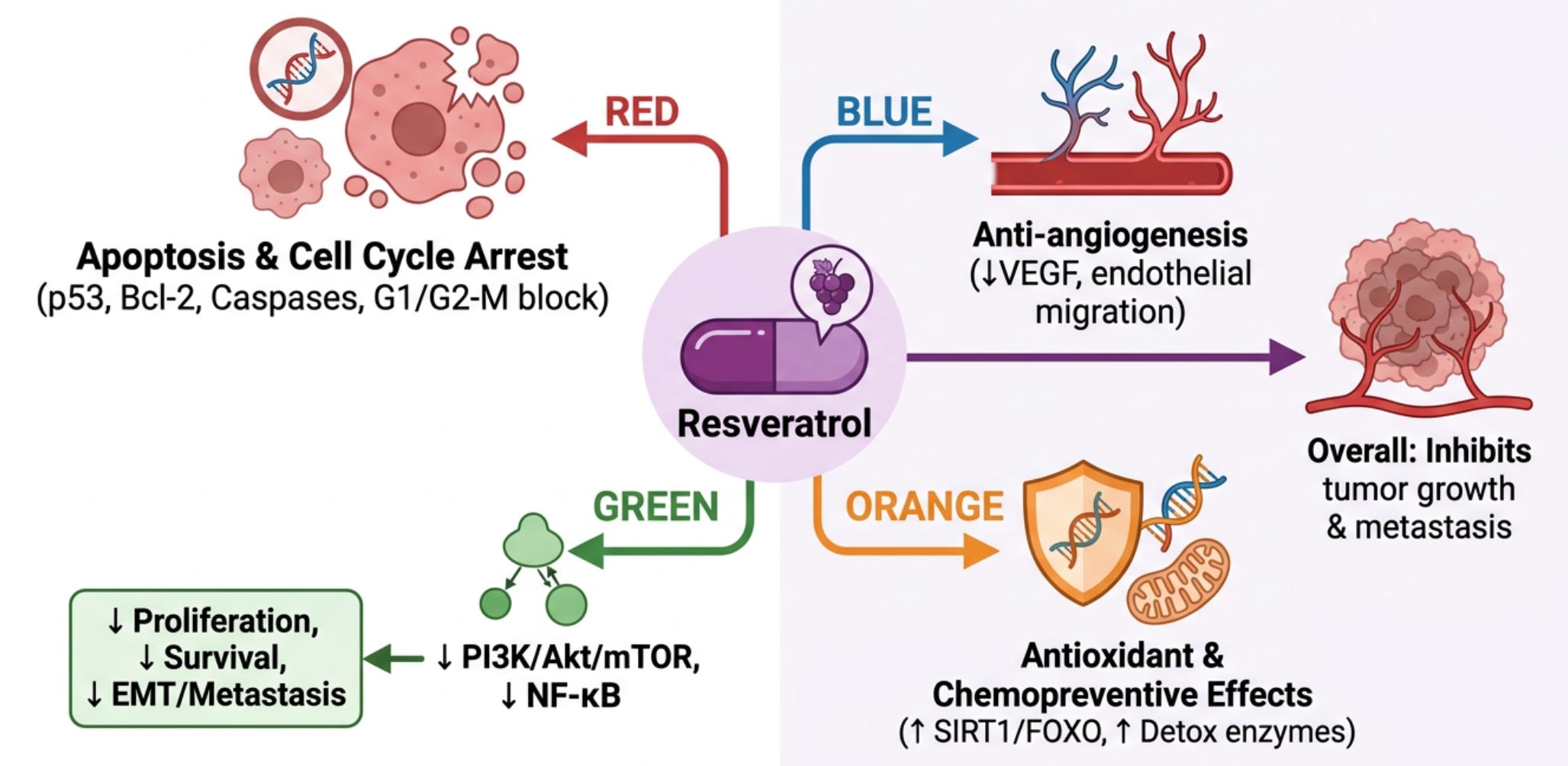
Flavonoids, as an antioxidant, inhibit regulatory enzymes and transcription factors which are important for controlling inflammatory mediators. Moreover, they modulate cellular oxidative stress by interacting with DNA and enhancing genomic stability. (12) Resveratrol also augments the activity and expression of antioxidant and phase-II detoxifying enzymes through the activation of nuclear factor E2–related factor 2 (Nrf2). Resveratrol inhibits angiogenesis by lowering VEGF expression and impairing endothelial cell responses, helping limit tumor vascularization and hypoxia‑driven progression.(13)
Preclinical research has demonstrated the effectiveness of flavonoids against inflammation-associated cancer progression. (12) Due to the association between inflammation and angiogenesis in tumor cells, experimental models demonstrate that flavonoids decrease angiogenesis and tumor metastasis. Resveratrol has been suggested to inhibit metastatic spread by inhibiting the expression of MMP (mainly MMP-9) and angiogenesis markers such as VEGF, EGFR, or FGF-2. (1, 14). Luteolin showed a potent capacity to target HIF-1α/VEGF signaling and angiogenesis. (15)
It has been reported that resveratrol can reverse multidrug resistance in cancer cells, and, when used in combination with clinically used drugs, it can sensitize cancer cells to standard chemotherapeutic agents. (1) In addition, it is likely that resveratrol has synergic activity against cancers when combined with GTCs.
Pterostilbene appears to be the most promising of the resveratrol analogs and significantly inhibited tumor growth, progression, local invasion and spontaneous metastasis in a mouse model of prostate cancer.(16) Studies have confirmed that pterostilbene exerts anti-proliferative and pro-apoptotic effects in various cancer cell types including lung, gastric, prostate, colon, breast cancers and CML and CLL.(17-19)
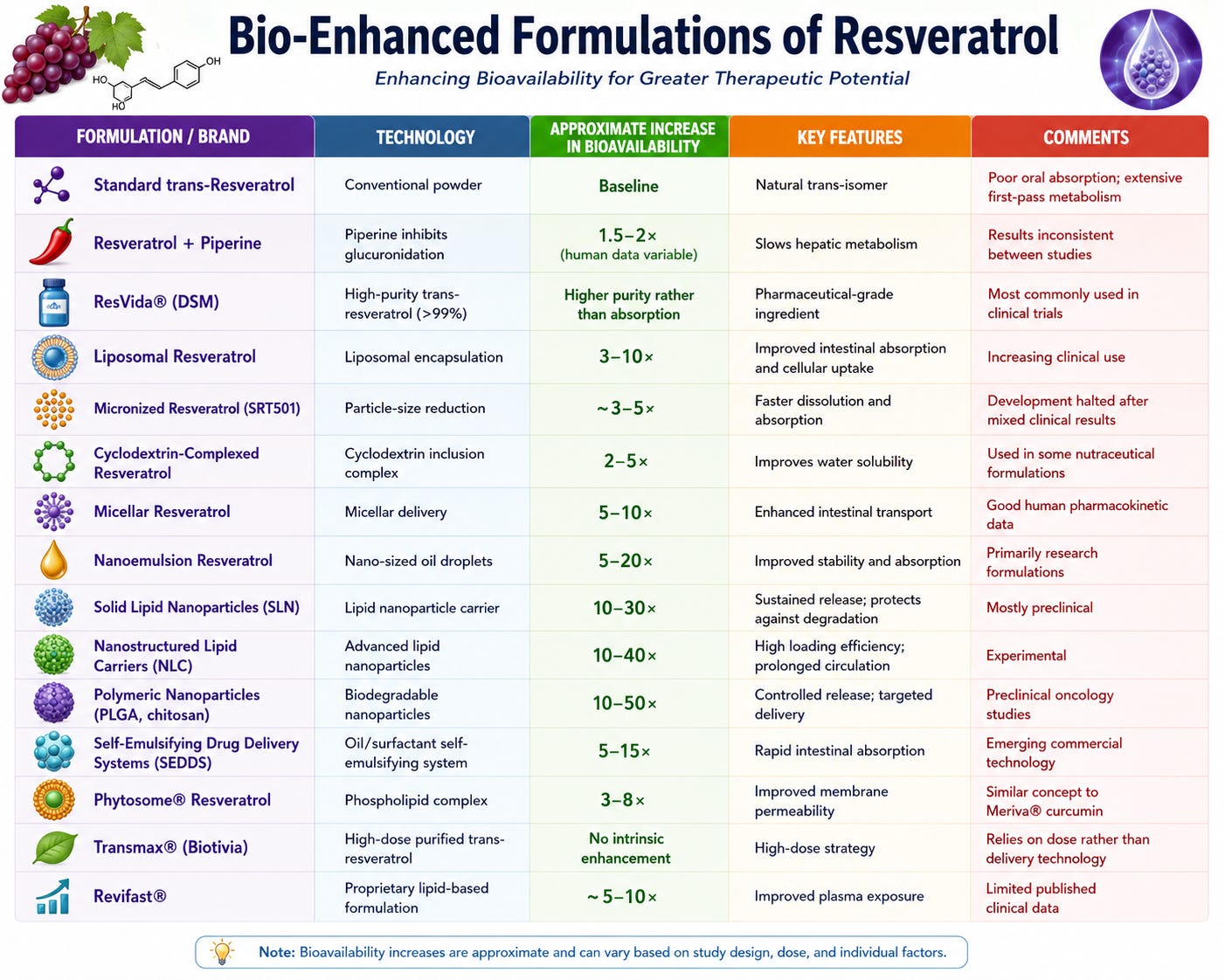
Conventional resveratrol has attracted considerable interest in oncology because of its broad anticancer effects, including inhibition of PI3K/Akt/mTOR, STAT3, NF-κB, HIF-1α, and Wnt/β-catenin signaling, suppression of cancer stem cells, improvement of mitochondrial function, and reduction of inflammation and angiogenesis. However, its clinical application has been limited by poor oral bioavailability, rapid metabolism, and low systemic concentrations. Bioenhanced formulations—including micronized, liposomal, phytosomal, nanoparticle, and cyclodextrin-complexed resveratrol, as well as trans-resveratrol combined with absorption enhancers—substantially increase plasma exposure and tissue delivery, potentially improving clinical efficacy. Within the Metabolic Trap framework, bioenhanced resveratrol is best viewed as a network modulator rather than a direct cytotoxic agent. It complements Axis 1 by activating AMPK and suppressing mTOR-driven anabolic metabolism, reinforces Axis 2 by targeting mitochondrial function and cancer stem cells while reducing metabolic plasticity, attenuates Axis 4 by inhibiting inflammatory cytokines, angiogenesis, and stromal remodeling within the tumor microenvironment, and supports Axis 5 through antioxidant, immunomodulatory, and circadian regulatory effects. When combined with agents such as metformin, berberine, doxycycline, ivermectin, curcumin, sulforaphane, and melatonin, bioenhanced resveratrol may exert synergistic multi-pathway pressure that limits tumor adaptation and resistance. Although high-quality randomized clinical data remain limited, the favorable safety profile and strong mechanistic rationale make bioenhanced resveratrol an attractive component of a multi-target metabolic oncology strategy.
Clinical studies
Although resveratrol has shown excellent anticancer properties, most of the studies were performed in cell culture and pre-clinical models. Despite strong preclinical data, human trials have been limited by low bioavailability due to rapid metabolism (glucuronidation, sulfation), prompting investigation of analogs, high‑dose regimens, and nano-formulations. Organ exposure appears highest in liver and kidney, and current clinical evidence supports chemo-preventive potential. (1) Pterostilbene may be the preferred formulation.
Types of cancers that resveratrol may be beneficial for
Resveratrol likely has anticancer effects in patients with breast, prostate, colorectal, hepatocellular, pancreatic, lung, and ovarian cancer. (1)
Dosing and cautions
Various approaches have been created to enhance the bioavailability of resveratrol, including consuming it with various foods, using it in combination with an additional phytochemical — piperine — and using a prodrug approach, micronized powders, or nanotechnological formulations. (1) A resveratrol dose of 500 mg twice daily is suggested. Bio-enhanced formulations are preferred ( see below).
Grape seed extract
Resveratrol and grape seed extract (GSE) both show anticancer activity in preclinical models, but they differ in primary targets, clinical evidence, safety signals, and how realistically they may be used in humans. Resveratrol has more human cancer‑related data (though still limited and mixed), whereas clinical evidence for GSE in oncology is almost entirely preclinical.
New Here?
Start with the: Cancer and the Metabolic Library

References
1. Ko JH, Sethi G, Um JY, Shanmugam MK, Arfuso F, Kumar AP, et al. The Role of Resveratrol in Cancer Therapy. Int. J Mol. Sci. 2017;18(12).
2. Kursvietiene L, Kopustinskiene DM, Staneviciene I, Mongirdiene A, Kubová K, Masteikova R, et al. Anti-Cancer Properties of Resveratrol: A Focus on Its Impact on Mitochondrial Functions. Antioxidants (Basel). 2023;12(12).
3. Varoni EM, Lo Faro AF, Sharifi-Rad J, Iriti M. Anticancer Molecular Mechanisms of Resveratrol. Front Nutr. 2016;3:8.
4. Tome-Carneiro J, Larrosa M, Gonzalez-Sarrias A, Tomas-Barberan FA, Garcia-Conesa MT, Espin JC. Resveratrol and clinical trials: the crossroad from in vitro studies to human evidence. Curr. Pharm Des. 2013;19(34):6064–93.
5. Kundu JK, Surh YJ. Cancer chemopreventive and therapeutic potential of resveratrol: mechanistic perspectives. Cancer Lett. 2008;269(2):243–61.
6. Harikumar KB, Kunnumakkara AB, Sethi G, Diagaradjane P, Anand P, Pandey MK, et al. Resveratrol, a multitargeted agent, can enhance antitumor activity of gemcitabine in vitro and in orthotopic mouse model of human pancreatic cancer. Int. J Cancer. 2010;127(2):257–68.
7. Benitez DA, Pozo-Guisado E, Alvarez-Barrientos A, Fernandez-Salguero PM, Castellon EA. Mechanisms involved in resveratrol-induced apoptosis and cell cycle arrest in prostate cancer-derived cell lines. J Androl. 2007;28(2):282–93.
8. Hsieh TC, Wong C, John BD, Wu JM. Regulation of p53 and cell proliferation by resveratrol and its derivatives in breast cancer cells: an in silico and biochemical approach targeting integrin avB3. Int. J Cancer. 2011;129(11):2732–43.
9. Aziz MH, Nihal M, Fu VX, Jarrard DF, Ahmad N. Resveratrol-caused apoptosis of human prostate carcinoma LNCaP cells is mediated via modulation of phosphatidylinositol 3’-kinase/Akt pathway and Bcl-2 family proteins. Mol. Cancer Ther. 2006;5(5):1335–41.
10. Bhardwaj A, Sethi G, Vadhan-Raj S, Bueso-Ramos C, Takada Y, Gaur U, et al. Resveratrol inhibits proliferation, induces apoptosis, and overcomes chemoresistance through down-regulation of STAT3 and nuclear factor-kappaB-regulated antiapoptotic and cell survival gene products in human multiple myeloma cells. Blood. 2007;109(6):2293–302.
11. Zhang L, Wen X, Li M, Li S, Zhao H. Targeting cancer stem cells and signaling pathways by resveratrol and pterostilbene. Biofactors. 2018;44(1):61–8.
12. Kubatka P, Mazurakova A, Samec M, Koklesova L, Zhai K, Kajo K, et al. Flavonoids against non-physiologic inflammation attributed to cancer initiation, development, and progression - 3PM pathways. EPMA Journal. 2021;12:559–87.
13. Berman AY, Motechin RA, Wiesenfeld MY, Holz MK. The therapeutic potential of resveratrol: a review of clinical trials. NPJ Precis Oncol. 2017;1.
14. Vergara D, Valente CM, Tinelli A, Siciliano C, Lorusso V, Acierno R, et al. Resveratrol inhibits the epidermal growth factor-induced epithelial mesenchymal transition in MCF-7 cells. Cancer Lett. 2011;310(1):1–8.
15. Li C, Wang Q, Shen S, Wei X, Li G. HIF-1a/VEGF signaling-mediated epithelial-mesenchymal transition and angiogenesis is critically involved in anti-metastasis effect of luteolin in melanoma cells. Phytother. Res. 2019;33(3):798–807.
16. Li K, Dias SJ, Rimando AM, Dhar S, Mizuno CS, Penman AD, et al. Pterostilbene acts through metastasis-associated protein 1 to inhibit tumor growth, progression and metastasis in prostate cancer. PLoS One. 2013;8(3):e57542.
17. Chen RJ, Kuo HC, Cheng LH, Lee YH, Chang WT, Wang BJ, et al. Apoptotic and Nonapoptotic Activities of Pterostilbene against Cancer. Int J Mol Sci. 2018;19(1).
18. Lee YH, Chen YY, Yeh YL, Wang YJ, Chen RJ. Stilbene Compounds Inhibit Tumor Growth by the Induction of Cellular Senescence and the Inhibition of Telomerase Activity. Int J Mol Sci. 2019;20(11).
19. Wang D, Guo H, Yang H, Wang D, Gao P, Wei W. Pterostilbene, An Active Constituent of Blueberries, Suppresses Proliferation Potential of Human Cholangiocarcinoma via Enhancing the Autophagic Flux. Front Pharmacol. 2019;10:1238.
Resveratrol is present in greater concentrations from Japanese Knotweed, (aka Polygonum cuspidatum and now taxonomically named Raynoutria japonica) is a major source of resveratrol, and is identified as the ingredient listed on many resveratrol formulations. It's an invasive plant in North America, the young shoots can be eaten and beekeepers like the flowers. The root is the main source for reserveratrol extraction and is available from a number of herb supply companies.
The root is also a broad antiviral, antimicrobial, effective against tick Bourne diseases, Sars-cov-2 and HIV-1.
I buy it organically grown in bulk, a pound at a time for making antiviral tinctures as well as for it's resveratrol content. It's a good invasive from that perspective.
Thank you, Dr Marik. Apparently, with glaucoma, resveratrol has neuroprotective properties (at the optic nerve head), as well as possessing the ability to decrease inflammation at the trabecular meshwork and Schlemm’s canal and hence increase aqueous outflow.